The Cropped Picture Problem: What the Frame Leaves Out
Learn how to read a cropped picture by separating visible evidence from assumptions, so you can describe its subject and action without overclaiming.
A hand reaches into a photograph, fingers curled around something just beyond the edge. Is it taking an object, offering one, or steadying a person? A cropped picture can make each story seem plausible while showing none of them in full. Reading a cropped picture carefully means distinguishing what the frame actually contains from what the viewer supplies.
The frame is the boundary of the image as presented. Cropping removes part of a larger view, but the missing area is not always simply empty background. It may contain a person, object, gesture, or clue that changes how the visible parts are understood. Even when an image was composed to fit its frame from the start, the same question applies: what does the boundary prevent us from seeing?
Evidence at the edge
Begin with details that can be pointed to directly. A visible wrist, a bent elbow, a table corner, or a shadow is evidence. “Someone is stealing a phone” is an interpretation: it assigns an identity, object, intention, and action that may not be established by the visible details.
This does not mean interpretation is useless. Images invite viewers to connect clues and infer what may be happening. The useful distinction is between a claim supported by what is visible and a claim that depends on information outside the frame.
Try describing the image in two passes. First, use literal terms: “A person’s hand is beside a small dark object on a counter.” Then add a clearly marked possibility: “The hand may be picking it up.” If the picture does not reveal what the object is or what happens next, preserve that uncertainty in the description.
How crops shift meaning
A crop can alter an apparent action by hiding its beginning or end. A person with one arm raised might be waving, reaching for a shelf, or shielding their face. The arm’s position is visible; the purpose depends on surrounding details, some of which may have been cut away.
It can also change who seems to be involved. A close crop of two people’s hands may suggest an exchange, but the wider scene could show them playing a game, preparing food, or working with a shared tool. The crop makes the hands prominent without proving the relationship between the people or the reason for their movement.
Scale and placement matter, too. A small object near the edge may look isolated when its owner is outside the frame. A face cut off at the forehead can feel anonymous or tense, although the wider image might provide a familiar setting or a relaxed expression. These impressions are real responses to the crop, but they are not the same as evidence about the full scene.
Ask what the crop changes about the apparent subject, action, and relationship. Keep those as separate questions rather than letting one quick story answer all three.
Visible and inferred
A careful reading can use three levels of description:
- Visible detail: What shape, object, person, gesture, or setting can you identify in the image?
- Supported inference: What interpretation fits those details, while remaining open to alternatives?
- Unknown context: What would require seeing beyond the frame or learning how the image was made?
For instance, “a person is holding a cup” may be directly visible. “The person is raising a toast” could be a reasonable inference if others are visibly responding, but it remains an interpretation. “The picture was taken at a celebration” may be unknown if no setting or other clue supports it.
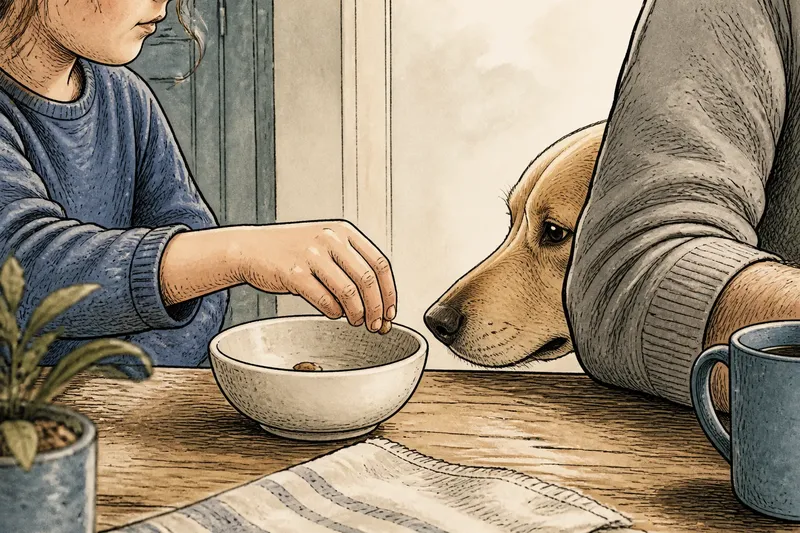
Imagine a cropped image showing a child’s hand and a dog’s muzzle beside a bowl. You can say that the hand is near the bowl and the dog’s muzzle is beside it. You might infer that the child is feeding the dog, but the crop does not establish whether food is being given, taken away, or simply moved. A wider view showing the bowl’s contents and the people nearby could clarify the action; without it, the careful description stays with what is shown.
Context and missing clues
Context includes more than the surrounding objects. It can include what happened immediately before or after the captured moment, the image’s caption, where it appeared, and whether it was edited. Those sources may help explain a crop, but they should not be confused with details visible in the image itself.
A caption can identify a person or event, while a neighboring headline can suggest a particular interpretation. Such information may be accurate, but it also frames the viewer’s reading. When assessing an image, separate the visual claim from the accompanying claim: note what the picture shows, then note what the caption says it shows.
Sometimes a crop is made for an ordinary reason, such as fitting a picture into a narrow layout. In other cases, removing context can make a scene seem more dramatic, intimate, or confrontational. The crop alone may not reveal why it was chosen. It is safer to describe its effect on the image than to assert the editor’s motive.
What does the crop support?
Can a crop change an image’s meaning?
Yes. Removing nearby people, objects, or setting can make a visible gesture seem to have a different purpose. The crop changes the evidence available to the viewer, even if the remaining pixels are unchanged.
How can I tell what is outside the frame?
You usually cannot know from the cropped image alone. Look for clues at the boundary, such as a partial object or a continuation of a gesture, but treat any reconstruction beyond those clues as a possibility rather than a fact.
Is a caption enough to settle the interpretation?
A caption can provide useful context, but it is still information supplied alongside the image. Compare its description with visible details and keep any mismatch or uncertainty clear.
What is a careful way to describe a cropped image?
Name the visible people, objects, and actions first, then qualify interpretations with words such as “appears” or “may.” Avoid assigning motives, relationships, or events unless the image or reliable accompanying context supports them.
A disciplined description
When writing about a cropped picture, choose verbs that match the evidence. “Touches,” “holds,” and “stands beside” often describe visible relations; “rescues,” “confronts,” and “steals” make stronger claims about purpose or sequence. A stronger verb may be justified, but it needs stronger evidence.
Also notice where the frame cuts through a person or object. A partial sleeve does not identify its wearer, and a cut-off tool does not show what it is being used for. If the missing portion matters, say so plainly: “The image shows a hand gripping a handle, but the object extends beyond the frame.”
Separating visible evidence from inference does not drain an image of meaning. It makes the reading more precise, leaving room for plausible interpretations without presenting one as certain. The next time a crop seems to tell a complete story, check the edges and ask which part of that story the frame actually shows.